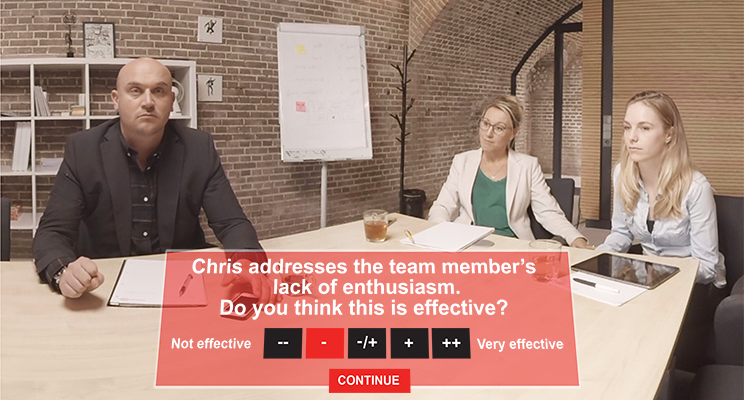
Traditional assessments primarily measure what people say they would do. In high-pressure roles, however, performance is determined by what people actually do when information is incomplete, time is limited and social or moral dilemmas arise.
Together with assessment and behavioural science partners, the ambition was to develop a fundamentally different approach: a Virtual Reality–based Situational Judgement Test (SJT) that places candidates in realistic work situations and measures behaviour rather than intention.
The challenge was multi-layered. The solution had to be scientifically valid, psychologically sound, technologically robust and practically deployable within professional assessment practice. Innovation without validation or adoption would not be acceptable.
I was responsible for the strategic and conceptual development of the VR assessment, working closely with behavioural psychologists, assessment experts and technology partners.
My responsibilities included:
Translating behavioural and psychological frameworks into experiential scenarios
Defining strategic design principles for realism, pressure and decision-making
Providing conceptual direction across behaviour, context and immersion
Safeguarding scientific validity alongside usability and scalability
Aligning innovation goals with assessment practice and adoption requirements
My role focused on connecting science, technology and real-world decision-making into one coherent assessment instrument.
The core strategic choice was to move away from questionnaires and hypothetical reasoning. Candidates were placed in realistic situations where they had to act, decide and prioritise under pressure. This shifted the assessment focus from intention to observable behaviour.
Virtual reality was not used as an experience enhancer, but as a methodological tool. Immersion was deliberately designed to introduce context, time pressure and social dynamics — all essential conditions for valid behavioural measurement.
From the outset, the assessment was designed to meet scientific validation standards while remaining practical for large-scale deployment. This ensured credibility among assessment professionals and long-term applicability beyond experimentation.
Development of the first validated VR-based Situational Judgement Test
Higher predictive value compared to traditional assessment methods
Improved candidate experience through realistic, engaging scenarios
Practical applicability for selection, development and leadership assessment
The solution bridged the gap between behavioural science, technology and professional HR practice.
This case illustrates how innovation gains value when it is grounded in behavioural insight and adoption logic. By designing immersion as a measurement tool rather than a novelty, technology enabled better decisions — not just more impressive experiences.