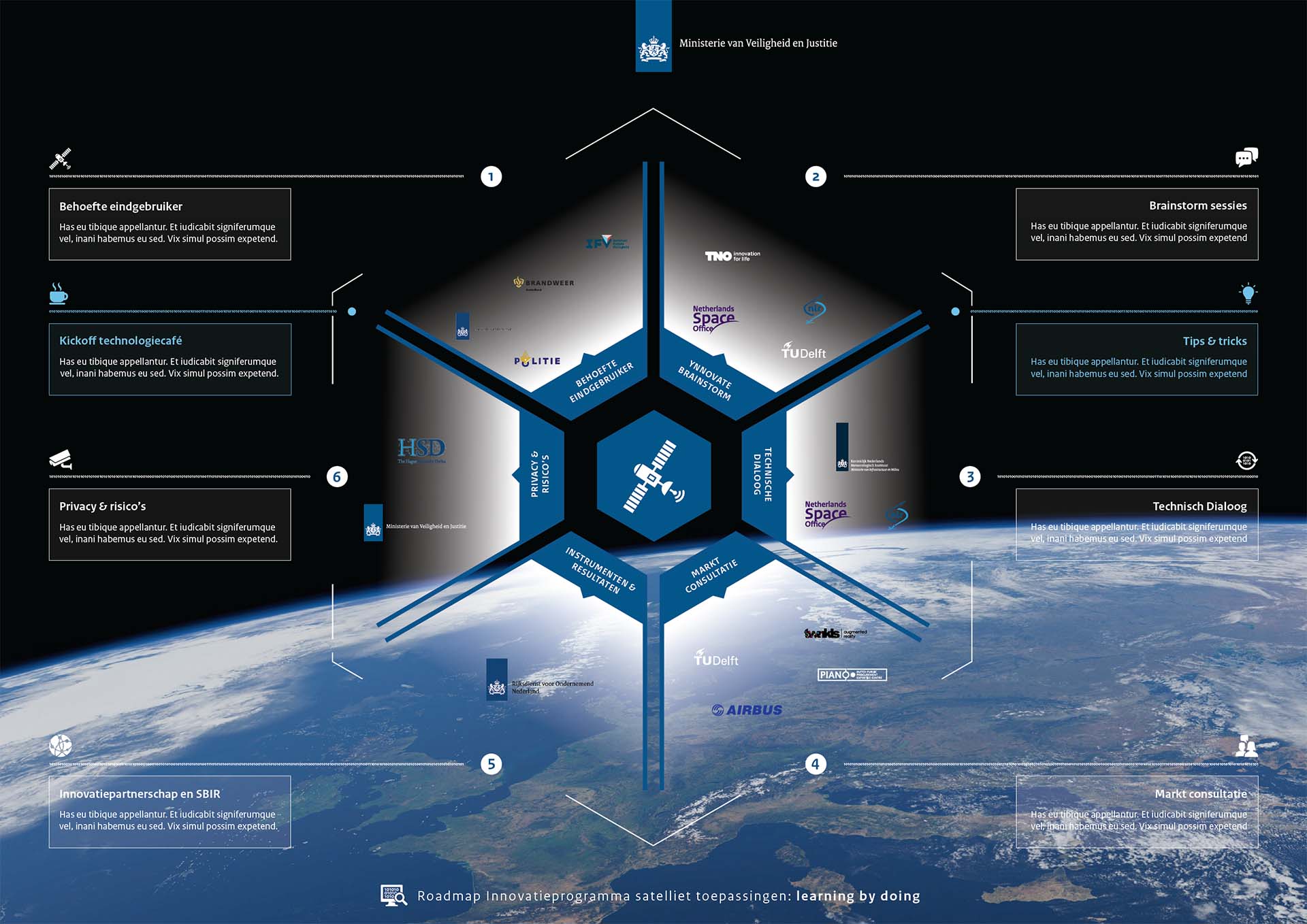
Innovation within government organisations is often associated with policy papers, long timelines and abstract ambitions. The Innovation Programme for Satellite Applications of the Ministry of Security & Justice required a different approach.
The programme brought together public authorities, knowledge institutions and private companies in a so-called triple helix collaboration, with the goal of applying satellite technology to real-world safety and security challenges. The complexity was not primarily technological, but organisational: multiple stakeholders, different interests, governance structures and levels of maturity had to align around a shared ambition.
The key challenge was to make innovation tangible, credible and actionable — internally within government and externally across partners — without oversimplifying the underlying complexity.
I was responsible for the strategic communication and positioning of the innovation programme, working closely with the Ministry and its public and private partners.
My responsibilities included:
Strategic positioning of the innovation programme
Development of an overarching narrative connecting stakeholders
Conceptual direction across communication formats and moments
Alignment with governance structures and decision-making processes
Safeguarding coherence between ambition, collaboration and execution
My role focused on meaning and alignment rather than communication output: ensuring that innovation became understandable, shared and actionable.
Rather than centring communication on technology itself, innovation was framed as collective action. Stories focused on the people, organisations and motivations behind the programme, positioning innovation as behaviour and cooperation rather than as a technical domain.
2. One narrative, multiple layersA single strategic narrative was developed and translated into different formats and contexts — from inspirational films to interactive presentations and visual overviews. This ensured consistency while allowing depth and nuance for different audiences.
3. Communication as an enabler of governanceCommunication was deliberately positioned as a strategic instrument to support alignment, ownership and legitimacy across the partnership. By clarifying purpose and roles, communication helped reduce friction and strengthen collaboration.
Improved understanding of the innovation programme across stakeholders
Stronger internal and external alignment around shared objectives
Increased engagement and sense of ownership among partners
Consistent positioning of innovation across communication moments
The programme narrative became more than communication: it functioned as a shared reference point for collaboration and decision-making.
This case illustrates how communication and strategy can accelerate innovation adoption within complex public ecosystems. When abstract ambition is translated into shared meaning and human collaboration, innovation becomes actionable, legitimate and sustainable.